
Towards Cyborg Guerillas
Case for Reworking the Image of the Insurgent

While my hope is that the title makes you think of a silverback gorilla with cyberpunk implants, I do also ask that you create a tabula rosa for what a guerrilla looks like. Within the imperial core, there is a tendency to create a Noble Savage archetype for those involved in insurgency. Low-tech, beating the imperial aggressor because of their commune with nature (James Cameron’s Avatar as the example). This ignores the reality that technology is not a core aspect of irregular warfare, but rather is a matter of the conditions as they exist.
In my article “Looting a Country (Prime Day Delivery)”, I used the term guerrillita to describe one who contributes to war in small/minor ways particularly through a “single click”. Though that begs the question: if the guerrillita can engage in warfare with a single click, what can the guerrilla do with multiple clicks? The landscape of war has been changing for quite a while. To paraphrase theorists Qiao Liang and Wang Xiangsui in Unrestricted Warfare: in the Napoleonic wars from which the guerrillas first arrived, battles were contained at singular Points; then as weaponry and tactics evolved, we witnessed the great Line wars of WWI and WWII; with the arrival of the US’s Revolution in Military Affair, we have witnessed a new dimension be added making warfare impossible to contain to a line. But as the authors point out, this new dimension isn’t necessarily in space. It is in non-military means where the war is stretching into.
When Che Guevara was moving through the rural landscape of Cuba, the image of the guerilla was one who utilized nature as their fog of war. Now, the fog of war can be lifted anywhere. In his book Guerilla Warfare, Che even makes explicit mention of the idea to move at night under the cover of trees to avoid detection. But how does one avoid detection when the enemy has the means to see at night? Even in the Vietnam War, Blufor was experimenting with means to detect covered movement. No longer is it planes that hunt for Redfor, it is a network. Where less than a century ago, it was crude oil that fueled war, now it is data that pushes the war machine.
This substack aims to follow in the footsteps of A. Neuberg to discuss and analyze the latest developments in the art of armed insurrection and proletarian military science. It does not act as an advocacy, but a theoretical analysis of what Blufor and Redfor, NATO’s designation for friendly and enemy units, would do. We must ask what is the modern guerrilla packing for themselves lest we get taken into fantasies.
Every Guerilla a Warrant Officer
“while i did complete a four year apprenticeship in software engineering (which definitely helped with acquiring some of the basic required skills), i have not studied cybersecurity—or anything else, for that matter. it's not just me either; basically everyone im friends with in both corporate infosec and the hacktivism scene has a similar background too, with some sort of basic computer science education and then lots of self-teaching and experience-gathering by just sorta... fucking around with stuff.”
- Maia Arson Crimew, 2024
The United States Marine Corps operates on the concept of “Every Marine a rifleman”. Pete Hegseth’s 100 general speech reputed the “cubicle soldier”, elevating this “warrior” concept embodied on the USMC’s rifleman doctrine. But Hegseth’s issue is that he does not understand that the Network Battlefield necessitates the “cubicle soldier” that he loathes so much.
Civilian employment in the US Army has expanded since its very beginning from the initial clerks of the Continental Army to the modern desk employees of the DoW. The US tooth-to-tail ratio has shrunk over time with non-combat personnel increasing overall.
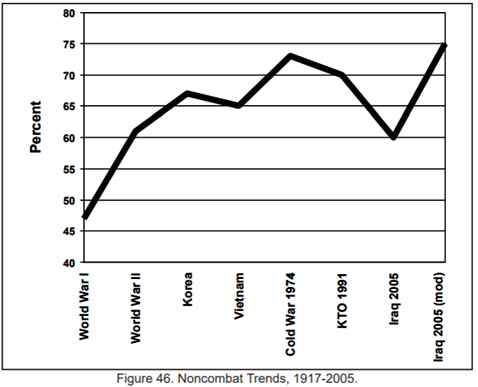
These trends didn’t spawn out of nowhere, they came with the mechanization and IoTing of the US military over time. While “tail” portions relatively decreased in the initial Iraq invasion, maintaining the occupation of Iraq required a continued use of the developments from the Revolution in Military Affairs. Those developments being the Network Battlefield. Now, it was no longer the case that armies were meeting at singular points or along lines of scrimmage. Instead the process of a “battle” occurs entirely in cyberspace. A RedInsurg in Iraq messages a peer, this electronic signal could be picked up by a Stringray, the data of this signal is sent through international lines typically in cooperation with Five Eyes, then processed at datacenters (hence the Pentagon’s continued funding and usage of AI), then if determined to be a threat, a Blufor group is sent to capture and torture the offending RedInsurg for further intelligence.
The anarchist Maia Arson Crimew makes the point in the quote above that hacking is not about taking cybersecurity classes, particularly because much of it is to bring you in to protect this militarized cyberspace. Instead it is about gaining and sharing information about the very function of the technology that surrounds us. This enters into the thought process of where the guerilla will begin to go. Rather than every guerilla a rifleman, every guerilla a warrant officer. Building technical expertise in just one of the legs of this networked battlefield, knowing how to take apart and put back together just one piece.
I will argue in the following sections why the modern guerilla army will continue to look like a corps of Warrant Officers, experts in technical subjects that allow them to counter Blufor’s or forward Refor’s objectives, accompanied by the “accidental guerrilla” of David Kilcullen who does much more of the trigger pulling.
The Iran, Hamas, Hezbollah Case
“It was Hezbollah with VHS tapes that started this process. And here they are in this war, and they’re giving us more footage in this war than we saw in previous rounds.”
-Jon Elmer, Electronic Intifada
As of writing this, Iran has reported the ability to strike the US’s latest jet fighter model the F-35. Elmer from the report above repeats the claims that this has been done via ambush tactics with short range infrared ballistic air defense set-ups. The US continually bragged that its radar signature was minimal and that it could detect and disrupt attempts to detect its movement’s via radar. Therefore, passive infrared detection was used to see the “invisible” plane and take it out. While the IRGC is certainly no rag-tag guerilla army, it provides the example for utilizing technological knowledge even when outgunned. Digging into claims made by the US and understanding the technical backings behind them will be a key part of Redfor tech operations in the coming years.
Media technology is an important aspect to RedInsurg activities when Blufor censorship and media control allows them to control the narrative. As mentioned in Unrestricted Warfare, U.S. media supremacy was part of the U.S. ability to win Desert Storm, as important as air supremacy. By controlling the narratives around Iraqi defeats, the U.S. was able to cause routs before even arriving. Hezbollah once used VHS, Hamas and other Palestinian groups now utilize telegram and USBs. The international cultural impact of the Red Arrow could not have occurred were it not for the development of media technology to take and distribute videos of Merkavas being destroyed. Israeli losses and their widespread recording seem to have struck enough fear that there are Israelis refusing to be drafted to save their lives.
Then there is the question of hacking. Handala Group, linked to Iran’s Ministry of Iranian Security, has been extremely active lately; wiping out hundreds of thousands of devices from a company that contracted with the US DOD, leaking the FBI Director’s emails and accounts, compromising US radar networks, and doxxing Lockheed Martin staff. However, the link is unknown, in the articles linked before it is explained that software is shared with MOIS established groups, but it wouldn’t be clear whether this is a group receiving help or at the direction of the MOIS. Yet, this proves that major guerilla-type damage can be caused by those with technical knowledge around the internet, viruses, and computers.
These three areas of technical expertise are removed from the battlefield and can easily be imagined being done by someone sitting at their desk in a button-up. Yet, they are crucial parts of the larger war effort. The skills needed for these tasks could only realistically be developed in those most ideologically committed to the particular insurgency so as to prevent a military brain drain. But that ideologically committed group is expected to be quite small, how can RedInsurg ensure that there is enough people left over to fire munitions, outside of the cubicle.
The Accidental and the Cyborg
“The most intriguing thing about this battle was not the Taliban, though; it was the behavior of the local people. One reason the patrol was so heavily pinned down was that its retreat, back down the only road along the valley floor, was cut off by a group of farmers who had been working in the fields and, seeing the ambush begin, rushed home to fetch their weapons and join in. Three nearby villages participated, with people coming from as far as 5 kilometers away, spontaneously marching to the sound of the guns. There is no evidence that the locals cooperated directly with the Taliban; indeed, it seems they had no directly political reason to get involved in the fight (several, questioned afterward, said they had no love for the Taliban and were generally well-disposed toward the Americans in the area). But, they said, when the battle was right there in front of them, how could they not join in? Did we understand just how boring it was to be a teenager in a valley in central Afghanistan? This was the most exciting thing that had happened in their valley in years. It would have shamed them to stand by and wait it out, they said.
[…]
“All but the full-time Taliban (and even potentially some of them) are reconcilable under some circumstances, in my view. Perhaps 3,000–4,000 fighters, therefore, or about 10 percent of the total, are hard-core fanatics who are not reconcilable under any circumstances and thus have to be dealt with through police and military security measures. The remaining 90 percent, in my judgment and that of most Afghans I have asked, are actually or potentially co-optable, though any such attempt at cooption would have to be conducted from a position of strength lest insurgent leaders (or, more importantly, local communities) interpret this as a Taliban victory. The Afghan governor quoted in the epigraph to this chapter, who believes that 90 percent of so-called Taliban are potentially reconcilable, shares this view, as did a recently surrendered Taliban leader who defected to the government side in early 2008 and whom I interviewed, along with 11 local and tribal elders from his district, in March 2008.”
-David Kilcullen, The Accidental Guerilla
Kilcullen answers the question that we were left with in the last section. That the day-to-day fighting is overwhelmingly handled by locals who see fighting not as a matter of ideological motivation or particular loyalty to RedInsurg, but instead out of a sense of surviving and thriving. With Blufor either being seen as a threat to livelihood or attacking Blufor seen as a benefit to livelihood. Taber’s War of the Flea comes to a similar conclusion about the Vietnam war where most fighters were not particularly drawn to communism per say, but instead that the communists were the ones fighting off the invaders and protecting the locals.
Projects like ICE list have caught the attention of mainstream media platforms like the New York Post for exposing thousands of DHS agents’ information. Various online tools for tracking ICE vehicles are now vibe coded out. Chinese satellite imagery of US foreign bases are being publicly posted in the middle of a war. The information and tools are dispersed and largely volunteer-run, but it would not be a stretch to see Redfor begin putting together the infrastructure to build their “cyborgs”. Individuals trained and specialized in technical arenas, using computers to create rallying points for the accidental guerrilla.
From Haraway’s Cyborg Manifesto, “Any objects or persons can be reasonably thought of in terms of disassembly and reassembly; no ‘natural’ architectures constrain system design. The financial districts in all the world’s cities, as well as the export-processing and free-trade zones, proclaim this elementary fact of ‘late capitalism’. The entire universe of objects that can be known scientifically must be formulated as problems in communications engineering (for the managers) or theories of the text (for those who would resist). Both are cyborg semiologies.” While partially cursed with the anarchist theory tendency to become as unreadable as possible, I enjoy the poetic idea that as we integrate knowledge of how to assemble and disassemble the technology used in our oppression, we integrate that technology into ourselves like a cyborg.
It is not out of the question for a future RedInsurg to have ideologically-dedicated officers trained in something like web-scraping to find and publish the information of those who support Blufor (a tactic used by organized Zionists) and then for locally developed armed groups to see that as a bounty. October of 2025, DHS made clear that this scenario was something they considered to be a real threat against them with them alleging that there already exists a bounty system for them. While we must take DHS’s word with a grain of salt considering their propensity for lying about events like the Pretti and Goode shootings, it does seem like this is a set up that they too have considered.
Both domestic RedInsurg and foreign Redfor must reckon with a Network Battlefield in order to effectively challenge a still-dominant Blufor. However, because the network is everywhere from pipelines to social media, Blufor’s maneuvers to play defense on this battlefield will be unsustainable. If Redfor desires to win, they will need to develop along this Cyborg-Accidental model; if Blufor desires to win, they must repeat Desert Storm to rapidly attack enemy computational infrastructure, win over the accidental through programs of appeasement, and then isolate and eliminate the remaining committed members. This places an uneven weight on Blufor that could make a retreat inevitable even if only to regroup and retry.
This was “Towards Cyborg Guerillas”. B. Neuberg Desk is a substack dedicated to the analysis and discussion of the latest in insurrectionary warfare and proletarian military science. This substack makes no advocacy for specific acts. If you’d like to read more, please follow and share with friends or coworkers.